Why retaining walls fail here — and it's almost never the rock
Hardscape 4 min read
A leaning wall is a drainage problem wearing a stone costume. What actually holds a slope back in freeze-thaw country, and how to spot a wall that was built wrong.
We get called to look at leaning walls two or three times a season. The owner almost always opens with some version of “I think the rock is too small.”
It’s almost never the rock.
#What’s actually pushing on the wall
A retaining wall holds back soil. Soil on its own is heavy but predictable. Soil full of water is a different material entirely — it weighs far more, and it behaves like a liquid pressing outward across the whole back face of the wall.
That outward push is called hydrostatic pressure, and in the Carson Valley it gets a second job: when saturated soil freezes, it expands. Every freeze-thaw cycle levers the wall a little further forward. It never levers back.
So a wall that looked fine in November is out of plumb by March, and nobody saw it move.
#The part of the wall you can’t see is the part doing the work
Behind a wall built properly there’s a zone of clean drain rock — typically ¾-inch angular gravel, not round river rock — wrapped in filter fabric, sitting on a perforated pipe that runs to daylight.
That assembly does three things:
- Water reaches the pipe instead of the soil. Gravel drains almost instantly.
- The fabric keeps fines out of the gravel. Without it, silt washes in and the drain rock turns into dirt within a few years.
- The pipe takes water somewhere. A drain that terminates inside the backfill is not a drain, it’s a bathtub.
#The base matters as much as the drainage
The other half of the failures we see are foundation problems.
- Topsoil under the first course. Topsoil compresses and holds water. The first course has to sit on compacted road base over competent native soil, not on the loose stuff that was there.
- No embedment. The bottom course should be buried — a rough rule is one-tenth of the wall height, and at least one full course. A wall sitting on the surface has nothing resisting it at the toe.
- Base not compacted in lifts. Dumping eight inches of base and running a plate over the top compacts the top three inches. The rest settles later, unevenly.
#How to tell if your wall is in trouble
Walk it after a wet spell. You’re looking for:
- Courses that no longer line up — sight along the face from one end
- A wall that leans out at the top rather than sitting plumb or tipped slightly back
- Water seeping through the face — that’s water that should have gone out the drain
- Soil or mulch washing out between stones
- A gap opening between the wall and the ground behind it
One of these on its own might be cosmetic. Two or more together means it’s moving.
#What a properly built wall costs you in extra work
Honestly: a lot of digging.
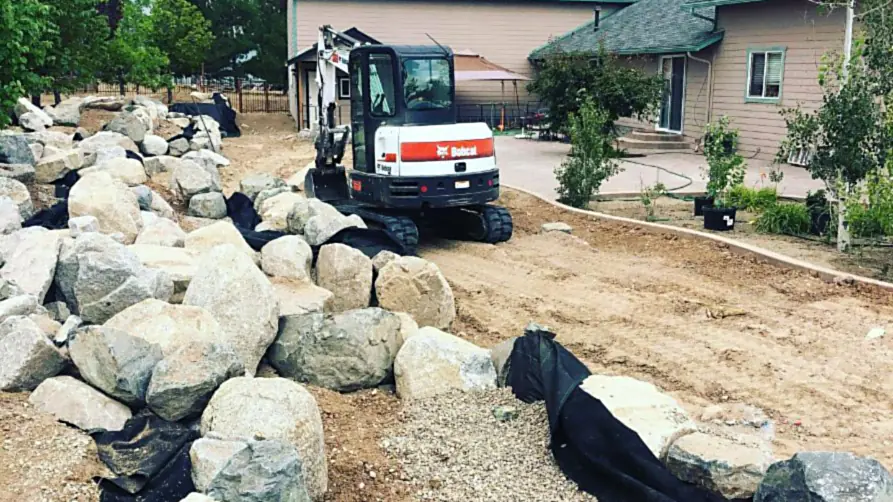
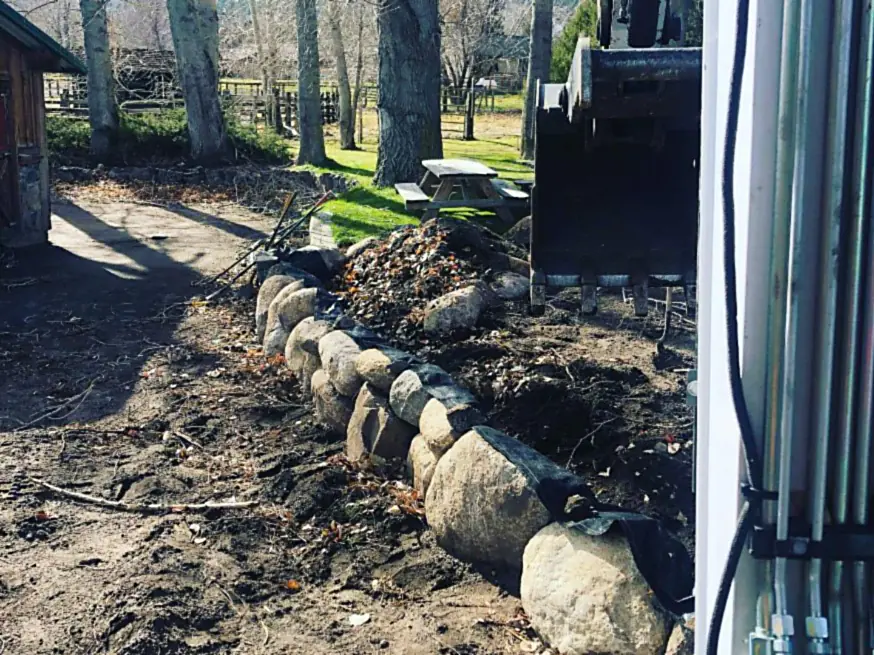
For a typical 3-foot boulder wall we’re excavating back 2 to 3 feet behind the wall line, well past where the stone will sit, to make room for the drainage zone. That excavation, the drain rock, the fabric and the pipe are usually a meaningful share of the job — and none of it is visible when we’re finished.
That’s the part that’s tempting to skip, and it’s the entire reason some walls last thirty years and some lean in three.
#Tiering instead of going tall
Above about 4 feet, a single wall starts needing engineering — and in many jurisdictions, a permit. Often the better answer isn’t a taller wall but two shorter ones with a planted bench between them.
Two 3-foot walls with 4 feet of level ground between them hold the same grade as one 6-foot wall, cost less to build properly, look better, and give you somewhere to put plants.
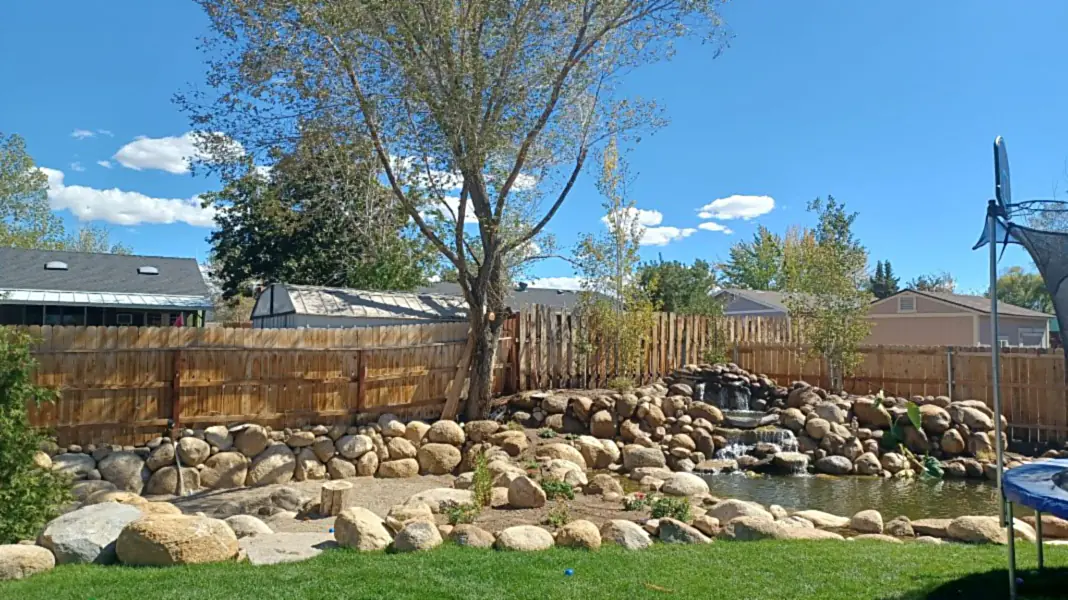
We build boulder and block walls across the Carson Valley. If you’ve got a wall that’s started to move, or a slope you need held, we’ll come and look at it — no charge for the visit.
- retaining walls
- drainage
- hardscape
- freeze-thaw